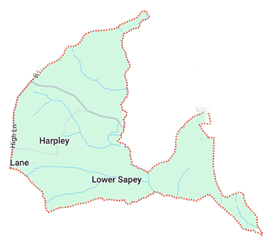
Lower Sapey and Harpley
The Story of Lower Sapey and Harpley – A Community Through the Centuries
Medieval Roots and the Old Church
Before the winding lanes of Harpley and its hilltop views became the centre of parish life, the heart of the community lay lower in the valley beside the murmuring Sapey Brook. Here stood the Old Lower Sapey Church, whose story reaches back over a thousand years, even before the Norman Conquest. It is recorded in the Domesday Book of 1066, and excavations have revealed traces of an 8th-century burial, placing its origins deep in the early Saxon age.
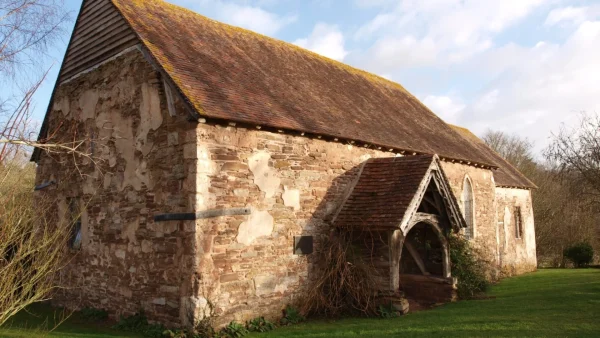
In the Middle Ages, the valley was home to a small monastery, serving both the church and the nearby Sapey Court, the local seat of justice. Pilgrims travelling between the abbeys of Shrewsbury and Tewkesbury found food and shelter here, and the steady toll of bells mingled with the sound of the brook and the lowing of cattle.
But time brought upheaval. The Black Death of 1365 devastated the population of Lower Sapey, leaving the church isolated amid overgrown meadows and silent stones. After the Reformation, the monastery’s life came to an end. Its lands were converted into farmland, and the buildings became Church Farm, their stone walls turned to barns and animal shelters. For centuries afterwards, the old site slumbered — its sacred buildings softened by ivy and silence.
The Plague and the Shift to Harpley
In the centuries that followed the plague, people gradually moved uphill, seeking drier ground and healthier air. The dampness of the valley made life hard, and so Harpley, perched high above the brook, grew into the new heart of the parish.
Yet the valley was never completely deserted. A handful of old farms remained, scattered along the winding course of the Sapey Brook — Church Farm, which took the place of the medieval monastery; Sapey Court, once the manor and later a working farm; Hill Farm and Ox Hall Farm on the rising slopes; and Hatt House and Burton Court Farm close to the stream. Hope Farm, though lying within Clifton Parish, still belongs to the story of the Lower Sapey valley, along with Hollands Mill nearby. Further downstream, within Tedstone Parish, the farms of Winley and Tidbatch mark the farthest traces of the old community that once lined the valley floor.
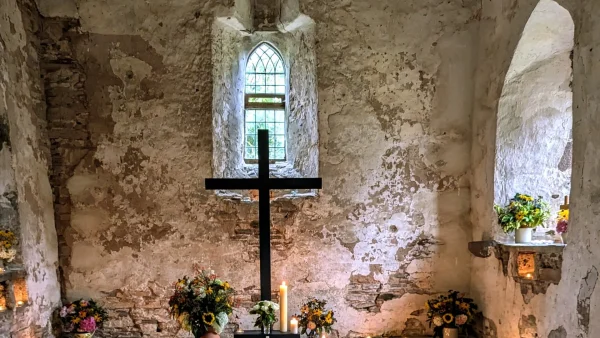
By the seventeenth century, the lower valley church had become little more than a memory. In time it even served as a chicken house, until in 1995 it was rescued and lovingly restored by the Churches Conservation Trust. Today it stands quiet among trees and wildflowers — a watchful survivor of more than a millennium of faith and human endurance.
The New Church of 1877
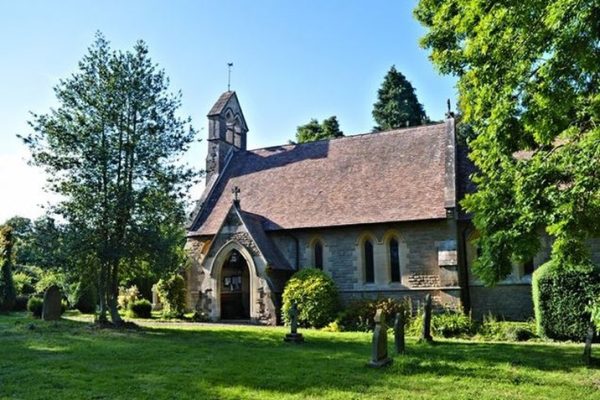
A true revival came in 1877, when Edward Bickerton Evans of Whitbourne Hall purchased the hamlet of Harpley with its rectorship. Having already built a Methodist church in Worcester, he turned his vision to this valley and raised a new church on higher ground — a beacon for a scattered farming community.
The font, carved from a single block of Norman stone, was brought lovingly from the old church below, linking past and present. A new stone was set beneath it, and a fence was added to protect worshippers from tripping over its finely crafted base.
The Evans family became the heartbeat of Harpley’s story. Alice Evans, affectionately known as Harpley Granny, built Harpley House in 1910 while lodging with the Dallow family of Culver House Farm. Two generations of Dallows served as Church Wardens for over fifty years. When Alice’s husband Patrick Evans died in 1902, she commissioned the East Window, installed around 1919, in memory of him and their son Rupert, who was lost in the Great War. The window’s design — featuring two wise men and a wise woman — was remarkable for its time, symbolising insight and equality.
The Farming Families of the Parish
Through every century, the lifeblood of Harpley and Lower Sapey has been its farming families. Their names echo through the records and the churchyard: the Dallows, Edwards, Richards, Smiths, Schermes, Skyrmes, and Delahays.
The Dallows, once of Culver House and later Park Horn, were wardens and hosts for generations. The Smiths, who farmed at The Gate Hangs Well, founded the first Worcestershire branch of the National Farmers’ Union. The Edwards farmed The Hope and Burton Court across the twentieth century, while the Richards family of The Hill and Church Farm gave the church its organists and wardens — most notably Bin and Grace Richards who played the organ for sixty years , their son David, and his wife Suzanne, who played for more than twenty years.
The Schermes ran the stone-moving business on the High Lane until the late twentieth century, later becoming Taylors of Martley. And the Delahays, who once farmed Sapey Court, remained tied to the parish moving to the Wheelys on the High Lane while the old court’s derelict shell was finally taken down in 1975. Its beams found new life in the Oak Inn on Bromyard Downs, where they still warm the hearth.
Harpley in the Twentieth Century
The twentieth century brought new rhythms but old loyalties. Harpley House remained in the Evans family until 2018, when it was bought by their cousin Nicholas Denniston, whose wife, Reverend Jen Denniston, now serves among the West Worcestershire parishes.
Women have long held guiding roles here. Margot Enderby, farmer and church warden, served for thirty years. Jane Edwards followed as secretary for two decades, and Valerie Edwards as warden for fifteen. Later came Marion West, Betty Nicholls, and Margaret and Mark Griffiths, alongside John and Pat Savage, who gave steadfast service to the church and its people.
The Ladies’ Group, formed in 1978, continues to meet each month, arranging flowers, planning carol services, and keeping fellowship alive. Their laughter still fills the vestry on quiet afternoons. The pop-up choir gathers whenever a joyful song calls for voices.
A Living Community Today
Harpley Church today is both ancient and forward-looking. It proudly holds Eco Church Silver Award status (2018), reflecting its care for creation and environmental stewardship. In 2015, Harpley founded the Sustainable Church Flower Movement, which now has more than a thousand members across the country — encouraging churches everywhere to celebrate the seasons and the natural beauty of their surroundings with sustainability in mind.
The churchyard hums with life: birds in their boxes, bats under the eaves, and wildflowers nurtured by an EU Natural Networks survey. The church welcomes Brownies and Scouts, as well as walkers and cyclists who pass along the lanes, and periodically holds guided walks around the parish, sharing its history, wildlife, and changing landscape with all who visit.
The parish celebrates royal occasions, an annual Big Breakfast, harvest festivals, arts and crafts, and concerts of music and poetry.
In 2027, the community will celebrate the 150th anniversary of the new church — a joyful tribute to the generations of farming families and newcomers who have shaped Harpley’s story.
Reflections on Continuity and Change
From Saxon settlers to twenty-first-century stewards, from monks beside the brook to choirs beneath stained glass, the story of Lower Sapey and Harpley is one of endurance and renewal.
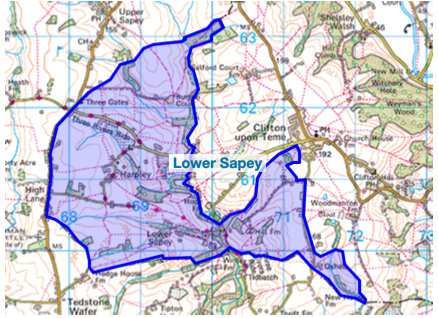
Even the shape of the parish itself tells part of the tale — its boundary curves across the hills and valleys in the graceful outline of a harp, the brook forming its lower curve and the ridge of Harpley rising where the strings might be drawn. It is as though the land itself was tuned to harmony, gathering the music of its people across the centuries.
The old church sleeps beside the water, more than a thousand years old, while above it the tower of 1877 still gathers its people beneath the same Worcestershire sky. The monastery may have faded, and the plough may have replaced the prayer book more than once, but the spirit of this parish remains — rooted in faith, community, and the gentle beauty of a landscape that has never forgotten its people.